News Alert: USCIS Policy Reframes Adjustment of Status as "Extraordinary Relief" as Agency Pushes Consular Processing

Image by BestGraphics_Com from Pixabay. On May 21, 2026, U.S. Citizenship and Immigration Services (USCIS) dropped a major policy shift with the publication of Policy Memorandum PM-602-0199, titled “Adjustment of Status is a Matter of Discretion and Administrative Grace, and an Extraordinary Relief that Permits Applicants to Dispense with the Ordinary Consular Visa Process,” sending shockwaves through the immigration community. It fundamentally changes the framework through which immigration officers view Form I-485, Adjustment of Status (AOS) applications. Learn more in our FAQ/News Alert.
What does the new USCIS Policy Memo (PM-602-0199) actually say?
The core change is not about statutory eligibility (the baseline rules you must meet to apply); rather, it is about administrative discretion.
While adjustment of status has always legally been a discretionary benefit, PM-602-0199 explicitly reframes the in-country green card process as an "extraordinary form of relief" and an "act of administrative grace." The memo establishes a general presumption that foreign nationals temporarily in the U.S. should return to their home countries and use the traditional Consular Processing route at a U.S. Embassy or Consulate abroad. According to the memo, officers are instructed to aggressively audit applications to determine whether an applicant truly deserves the privilege of adjusting status inside the United States.
Does this memo eliminate the ability to file for a Green Card inside the U.S.?
No. The memo does not change federal statutory law. Section 245 of the Immigration and Nationality Act (INA) still stands, and Congress has explicitly authorized Adjustment of Status for individuals who meet the technical benchmarks. It does, however, create a much higher evidentiary hurdle. An applicant can meet every single technical requirement for a green card but still be denied if the officer decides the negative factors outweigh the positive ones in their case.
How does this memo interact with long-standing federal regulations under 8 CFR § 245?
Federal regulations under 8 CFR Part 245 dictate the explicit procedural eligibility criteria for adjustment of status (e.g., lawful inspection and admission/parole, visa availability, and bars to adjustment).
The Conflict: Traditionally, if an individual complied with 8 CFR § 245, a favorable exercise of discretion was heavily assumed in the absence of major negative factors (like a serious criminal record).
The Shift: Under PM-602-0199, compliance with 8 CFR § 245 is merely step one. Step two requires a completely separate, heightened "discretionary gate." The memo mandates that simply lacking negative factors is no longer enough to win a favorable exercise of discretion. Applicants must actively build a record proving they warrant this "extraordinary relief."
What does the USCIS Policy Manual say about how discretion is evaluated?
To understand how deep this change goes, we look at the long-standing guidance found in the USCIS Policy Manual (Volume 7, Part B, Chapter 2). Historically, the Policy Manual set out a "totality of the circumstances" balancing test:
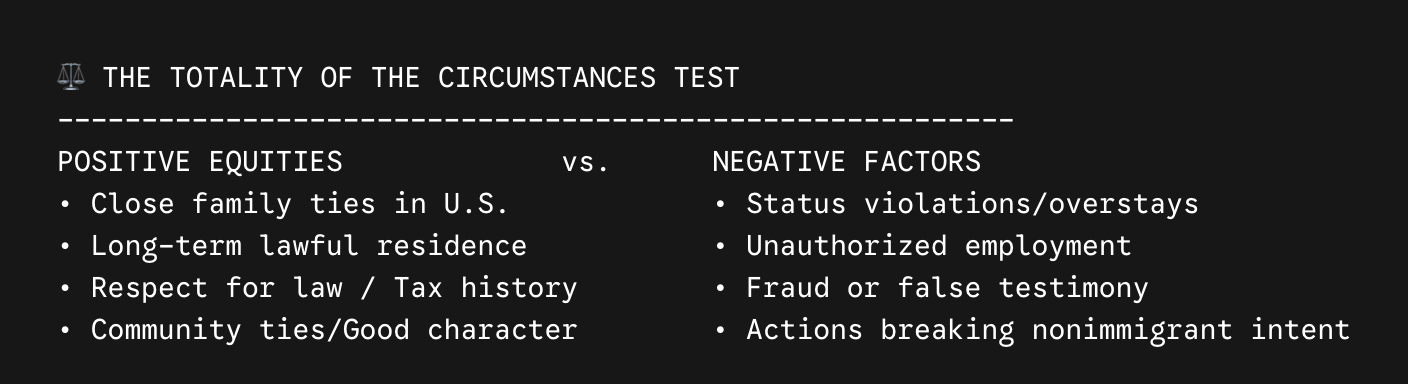
Under the new memo, the balancing scale has been dramatically altered. USCIS officers are instructed to weigh specific adverse factors much more heavily, with a particular focus on whether the applicant could have (or should have) pursued consular processing instead.
What specific negative factors are officers being told to scrutinize?
PM-602-0199 explicitly directs officers to heavily weigh the following "highly relevant" negative factors:
Any violation of immigration status: This includes visa overstays, periods of unlawful presence, or failing to maintain status.
Unauthorized employment: Even if technically exempt or forgivable under certain family-based categories, unpermitted work will be viewed as a negative discretionary factor.
Post-Admission Conduct Inconsistent with Visa Purpose: If an applicant entered on a temporary tourist (B-1/B-2) or student (F-1) visa and immediately filed for an adjustment of status, USCIS will view this as a circumvention of the consular process and an abuse of nonimmigrant intent.
Fraud or False Testimony: Any past or present misrepresentations made to a CBP officer at the border, a consular officer, or a USCIS official.
I am in H-1B or L-1 "Dual Intent" status. Am I safe?
The memo specifically addresses dual-intent nonimmigrant visa categories (such as H-1B, L-1, and their dependents). It clarifies that applying for adjustment of status while holding these statuses is not considered "inconsistent conduct" or a violation of intent.
However, there is a catch: The memo explicitly states that “maintaining lawful status in a dual intent nonimmigrant category is not sufficient, on its own, to warrant a favorable exercise of discretion.” Even H-1B and L-1 holders will now need to document robust positive equities in their applications to secure an approval.
If my case is denied based on discretion, can I appeal it in court?
The new policy memorandum explicitly positions discretionary denials as unreviewable by federal courts. Citing the Supreme Court precedent Patel v. Garland (2022), the memo states that USCIS discretionary findings during the adjustment process fall entirely under the agency's unreviewable authority (INA § 242(a)(2)(B)).
The silver lining is that the memo mandates that any officer issuing a discretionary denial must provide a detailed written analysis outlining every positive and negative factor considered, explaining exactly why the negative elements tilted the scale.
What should pending applicants or people preparing to file do right now?
Because we are in a window with no specific operational guidance regarding how currently pending or upcoming cases will be handled, the immediate takeaways are proactive mitigation:
Do Not Panic or Withdraw: If you have an application pending, do not withdraw it. Meeting the standard is harder, but it is not a ban.
Over-Document Positive Equities: When filing new cases (or preparing for a potential Request for Evidence (RFE) on a pending one), do not just send forms. Provide extensive documentation of your U.S. family ties, continuous history of filing U.S. taxes, letters of reference, proof of community involvement, and a flawless timeline of your lawful status.
Re-Evaluate Consular Processing: For certain high-risk applications—especially those with a history of minor status violations or tricky entry intent—processing the green card through a U.S. consulate abroad may now be a safer, more predictable option than trying to adjust domestically.
Avoid Unnecessary Travel: Traveling on Advance Parole while an adjustment application is pending has always carried minor risk, but under a heightened discretionary environment, it should be approached with extreme caution.
What else should I know?
This blog post discusses a highly recent, fluid, and developing policy shift issued on May 21, 2026. At this stage, there is no specific operational guidance regarding how USCIS will treat currently pending Form I-485 cases or how it will evaluate new applications waiting to be filed. The information provided below is for educational and informational purposes only and does not constitute formal legal advice. If you have an active or upcoming case, you are strongly encouraged to consult a qualified immigration attorney.
We will continue to monitor updates from USCIS regarding the implementation of PM-602-0199. Be sure to subscribe to our newsletter and check back regularly for updates as the agency releases category-specific operational guidance. Follow us on Instagram, Twitter, Facebook, LinkedIn, and TikTok, for up-to-date immigration news.
Torregoza Legal PLLC is the law firm for immigrants, by immigrants. We are founded on the motto of LegalEase: we do away with the legal jargon and make law easy to understand, so you can focus on what’s important to you – going for your American Dream.
Contact us at (888) 445-7066 or info@legalease.us. Find us on social media as @LegalEaseUS. || http://legalease.us/
This website and blog constitute attorney advertising. Do not consider anything on this website or blog legal advice as the law is dynamic, particularly in the immigration field and nothing in this website constitutes an attorney-client relationship being formed. Set up a one-hour consultation with us before acting on anything you read here. Past results are no guarantee of future results and prior results do not imply or predict future results. Each case is different and must be judged on its own merits.