
Photo by Vitaly Gariev on Unsplash. For visual artists, creatives in fashion, performing artists, and culinary visionaries, securing an O-1B visa (Extraordinary Ability in the Arts) is a major career milestone. It grants temporary authorization to work in the United States based on your high level of achievement and national or international recognition in your creative field. But what if you want something more permanent? Learn more in our Filing Tips.
For visual artists, fashion designers, performing artists, and culinary visionaries, securing an O-1B visa (Extraordinary Ability in the Arts) is a major career milestone. It grants temporary authorization to work in the United States based on a showing of "distinction"—meaning a high level of achievement and national or international recognition in your creative field.
However, because the O-1B is a temporary, nonimmigrant visa that requires an ongoing petitioner or agent and periodic renewals, many accomplished creatives naturally look toward the EB-1A (Extraordinary Ability Immigrant Visa) to secure permanent residency (a green card) and full professional independence.
While both categories focus on excellence in the arts, transitioning your profile from O-1B distinction to EB-1A extraordinary ability requires stepping up your evidentiary strategy. You must move from proving you are "distinguished and well-known" to proving you are at the very top of your field—and that your ongoing work will substantially benefit the United States in the future.
Understanding the Distinction: O-1B vs. EB-1A
To make this transition successfully, it helps to understand how USCIS adjudicates the two legal standards:
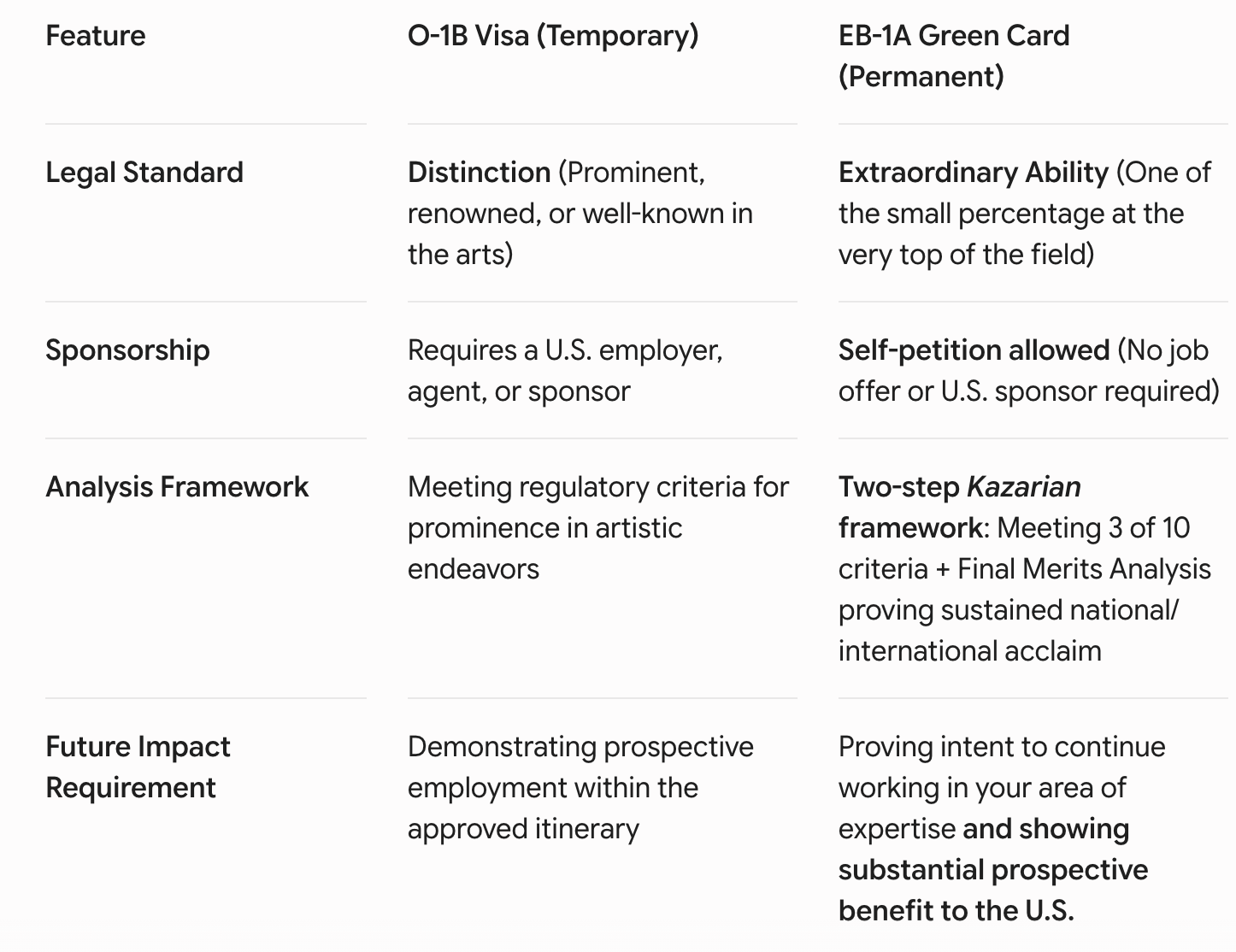
O-1B vs. EB-1A Standards. You need to be at the very top of your field to qualify for an EB-1A.
Examples of Transition Strategies
1. Visual Artists & Fine Artists
O-1B Focus: Gallery exhibitions, press reviews of solo or group shows, and featured artwork in art catalogs.
EB-1A Step-Up: Focus on institutional influence, judging, critical (awards) and commercial success. Secure opportunities to serve on jury panels for prestigious art grants or international competitions. Highlight high-value artwork sales, museum acquisitions, commercial brand partnerships, or original artistic techniques that have influenced contemporary art movements.
2. Creatives in Fashion
O-1B Focus: Runway showcases, celebrity styling, and press features in regional or national fashion media (Vogue, Harper's Bazaar).
EB-1A Step-Up: Transition to business leadership, original contribution, and major industry acclaim. Document leading or critical roles at distinguished fashion houses or as the founder of an influential brand. Provide proof of high commercial sales revenue, licensing deals, patents (such as sustainable textiles), or top-tier national fashion awards.
3. Performing Arts (Musicians, Dancers, Actors, Comics)
O-1B Focus: Lead or starring roles in major productions, tour itineraries, critical reviews, and media interviews.
EB-1A Step-Up: Demonstrate commercial dominance and peer adjudication. Highlight top box office or streaming revenue metrics, winning recognized national or international music/performing arts awards, serving as a judge or panelist for elite competitions, and establishing a lasting impact on your discipline through published methods or masterclasses.
4. Culinary Arts (Chefs & Gastronomists)
O-1B Focus: Executive chef positions, restaurant reviews in major outlets, and feature stories on culinary concepts.
EB-1A Step-Up: Focus on national importance, industry judging, and major original contributions. Document leadership roles at Michelin-starred or nationally renowned dining institutions, serve as an official judge in national culinary competitions or industry awards, and demonstrate how your culinary techniques, food science innovations, or cookbooks have reshaped the broader food industry.
Essential Milestones to Meet for an EB-1 Self-Petition
To build an EB-1A portfolio that passes both the initial 3-of-10 regulatory criteria threshold and the strict Final Merits Analysis, focus on accomplishing these key milestones during your time on an O-1B:
Milestone 1: Win Nationally or Internationally Recognized Prizes or Awards
Target: Move beyond local or institutional recognition to secure prizes awarded for excellence in your creative discipline.
Evidence: Official award certificates, competition criteria proving the award’s national/international scope, press coverage of the award ceremony, and documentation showing the panel of judges comprised recognized industry experts.
Milestone 2: Serve as a Judge of Others in Your Field
Target: Transition from being the artist on display to being the expert who adjudicates the work of peers.
Evidence: Formal invitation letters, judging rubrics, and documentation confirming you served on grant panels, competition jury boards, or peer-review committees for major artistic organizations or publications.
Milestone 3: Document "Original Contributions of Major Significance"
Target: Show that your creative work hasn't just been praised, but has fundamentally altered or heavily influenced your field.
Evidence: Detailed testimonial letters from independent industry leaders explaining how your work has been widely adopted or emulated, proof of patents/trademarks, or documented widespread impact on artistic trends.
Milestone 4: Hold a Leading or Critical Role for Distinguished Organizations
Target: Perform in a key capacity for entities that themselves carry a distinguished reputation.
Evidence: Organizational charts, contracts, press releases, and executive letters proving your specific contributions were critical to the success, reputation, or artistic output of a renowned gallery, fashion house, theater company, or restaurant group.
Milestone 5: Command High Remuneration or Commercial Success
Target: Prove that your artistic talent commands top-tier financial compensation compared to others in your discipline.
Evidence: Tax filings, paystubs, high-value client contracts, royalty statements, box office reports, or sales figures that rank in the top percentile for your specific artistic field.
Proving "Substantial Prospective Benefit to the United States"
Under the Immigration and Nationality Act (INA § 203(b)(1)(A)(iii)), an EB-1A applicant must prove that their continued presence and work in the U.S. will substantially benefit prospectively the United States.
While USCIS generally presumes that individuals who perform at the very top of their field inherently benefit the nation, creative professionals should explicitly document how their future endeavors will make a direct economic, cultural, educational, or societal impact in the U.S.
What Specific Evidence Can Prove Substantial Prospective Benefit?
Detailed Personal Statement & U.S. Activity Plan: Craft a comprehensive 3- to 5-year business plan or artistic roadmap detailing your upcoming projects, exhibitions, performances, product lines, or business ventures in the U.S. Explain how your continued presence will drive innovation and growth in your sector.
Demonstrate Economic Impact and Job Creation: Show how your projects generate economic activity. For instance, a fashion designer can highlight contracts with U.S. garment manufacturers, a chef can detail restaurant hiring plans and local supplier partnerships, and a performing artist can outline production budgets that pay local crews and venues.
Document Cultural and Educational Value: Highlight masterclasses, university guest lectures, mentorship initiatives for young American artists, or public cultural exhibitions you plan to lead. Demonstrating a commitment to enriching the U.S. cultural fabric and training the next generation of American talent provides compelling proof of prospective benefit.
Provide Letters of Intent and Future Contracts: Include deal memos, letters of intent, commission agreements, or booking confirmations for upcoming work in the U.S. This confirms that your future work is not hypothetical, but actively requested by U.S. entities.
Highlight Cross-Industry Innovation: If your work intersects with technology, sustainability, or social causes—such as zero-waste fashion manufacturing, sustainable agricultural sourcing in culinary arts, or digital art installations—emphasize how these broader impacts benefit American society beyond aesthetics alone.
Strategic Roadmap for Your Transition
Conduct a Gap Analysis Early: Evaluate your current O-1B evidence against the 10 EB-1A regulatory criteria at least 12–18 months before your O-1B expires.
Collect "Final Merits" Evidence Continuously: Remember that meeting 3 criteria is only step one. USCIS adjudicators evaluate the total record to see if you have sustained national or international acclaim. Keep a rolling portfolio of every major press article, award, sales report, and judging invitation.
Transition to a Self-Petitioner Mindset: Because the EB-1A allows self-petitioning, you do not need an employer to sponsor you. However, you must submit a clear personal statement and concrete documentation demonstrating your intent to continue working in your area of extraordinary ability and how that work substantially benefits the U.S.
Work with Experienced Legal Counsel: Partner with an immigration attorney who understands creative fields to ensure your petition presents a cohesive, narrative-driven case that meets the high EB-1A legal standard.
By strategically building on your O-1B foundation, meeting higher-level milestones, and clearly articulating your future benefit to the nation, you can successfully navigate the shift from temporary artistic distinction to a permanent EB-1A green card. Remember, immigration law is highly dynamic and each case is judged on its own merit. Contact us for a case evaluation. Follow us on Instagram, Twitter, Facebook, LinkedIn, and TikTok, for up-to-date immigration news.
Torregoza Legal PLLC is the law firm for immigrants, by immigrants. We are founded on the motto of LegalEase: we do away with the legal jargon and make law easy to understand, so you can focus on what’s important to you – going for your American Dream.
Contact us at (888) 445-7066 or info@legalease.us. Find us on social media as @LegalEaseUS. || http://legalease.us/
This website and blog constitute attorney advertising. Do not consider anything on this website or blog legal advice as the law is dynamic, particularly in the immigration field and nothing in this website constitutes an attorney-client relationship being formed. Set up a one-hour consultation with us before acting on anything you read here. Past results are no guarantee of future results and prior results do not imply or predict future results. Each case is different and must be judged on its own merits.